

Back to Blog
Subcutaneous Injection Sites: Diagram and Guide to Every SubQ Site
November 09, 2026
10 min read
Monica Hodgson
injection-sites
peptide-therapy
subcutaneous
Where to give a subcutaneous (subQ) injection, with a labeled diagram of the abdomen, thighs, arms and glutes. How to find each site, which one is easiest, and the spots to avoid.
You've got your vial, your syringes and your instructions. Then comes the question nobody seems to answer clearly: where exactly does the needle go?
Most peptides, and plenty of other medications, are given as subcutaneous injections. You'll see that shortened to subQ, sub q, SQ or SC, and they all mean the same thing. The needle goes into the layer of fat just under your skin, above the muscle. Nearly everyone has that layer in several places, which is why you have more than one good option.
This guide walks through every common subcutaneous injection site with a diagram, how to find each one, which is easiest for most people, and which spots to stay away from. Your healthcare provider has the final say on the sites you use, so think of this as background for that conversation. Once you've picked a site, our step-by-step guide to giving yourself a subcutaneous injection covers the injection itself.
Subcutaneous Injection Sites Diagram
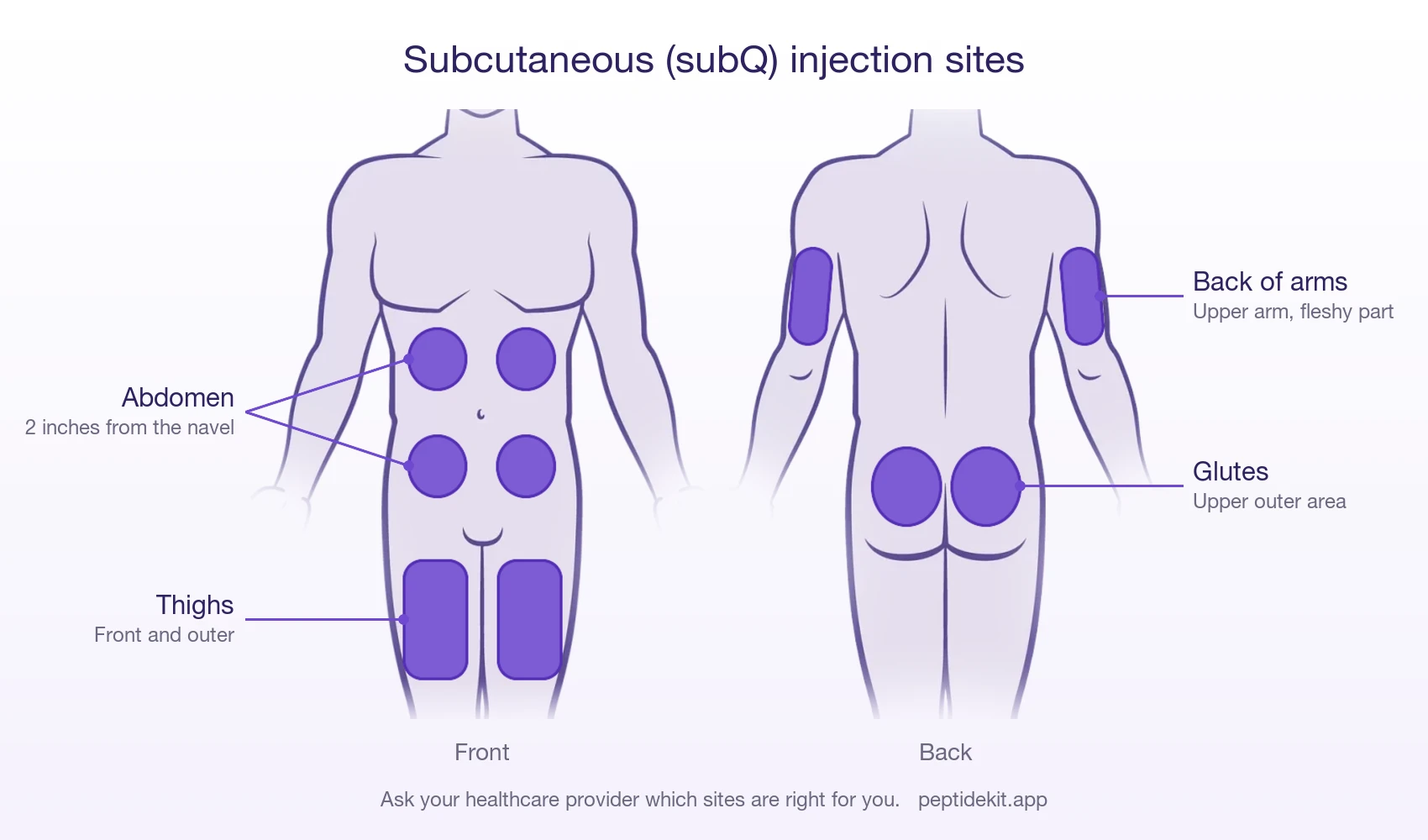
The diagram shows the four areas used most often for subQ shots:
Each area is big enough to hold several injection spots. That matters, because you'll want to move around inside an area as well as between areas. We'll come back to that.
What Makes a Good SubQ Site?
A good subcutaneous site has three things going for it. There's a decent layer of fat under the skin, so the medication lands in fat and not in muscle. It's away from large blood vessels, nerves, joints and bone. And you can see it and reach it, which matters a lot when you're the one holding the syringe.
The four areas in the diagram tick all three boxes for most adults. Other places can work (some providers use the upper back or the side of the waist), but those are usually for when someone else gives the shot.
The Abdomen Injection Site
The abdomen is the most popular subcutaneous injection site, and for good reason. Most people carry more fat there than anywhere else, it's easy to see, and you can reach it with either hand while sitting down.
Where to inject: the soft part of your belly between the bottom of your ribs and the top of your hip bones, at least 2 inches (about 5 cm) away from your belly button. That's roughly three finger widths. The tissue right around the navel is tougher and not a good place for a shot.
How to divide it up: picture a plus sign centered on your belly button. That splits your abdomen into four quarters: upper right, upper left, lower right and lower left. Treat each quarter as its own spot in your rotation and you'll always know where you are.
What to skip: your waistband or belt line, where clothing rubs, plus any scars, including old surgical ones. If you have stretch marks, inject between them rather than through them.
The Thigh Injection Site
Your thighs are the next easiest place to inject yourself. Use the front and outer part of the upper thigh.
To find it, place one hand just below the crease at the top of your thigh and the other hand just above your knee. The space between your hands, on the front and outer side of the leg, is your target. Stay away from the inner thigh, which has more blood vessels and nerves and tends to be more sensitive.
Some people find thigh shots a little less comfortable than belly shots because there's often less fat there, especially if you're lean or muscular. If that sounds like you, ask your provider whether pinching up a fold of skin would help.
The Back of the Upper Arm
The back of the upper arm works well, but it's the hardest site to reach on your own. Aim for the fleshy area roughly halfway between your shoulder and your elbow, on the back and outer side of the arm.
Plenty of people only use this site when a partner or caregiver gives the shot. If you can't see the spot clearly, or you have to twist to reach it, that's a good sign to choose a different area.
Arms usually have less fat than the abdomen, so the chance of going too deep is a bit higher, especially with longer needles. Our guide to injection sites and needle sizes explains how needle length and site fit together.
The Glutes (Upper Outer Buttocks)
The upper outer part of the buttocks has plenty of fat for subQ shots. Imagine one buttock divided into four quarters. The subQ area is the upper outer quarter, toward your hip.
You may hear that the same area is used for some intramuscular shots. That's true, but an intramuscular shot uses a much longer needle to reach the muscle, while a subQ shot only goes into the fat. Same area, different depth.
Like the arms, this site is hard to see yourself, and twisting around makes a steady hand harder. It's most often used when someone else is helping.
Is There a "Best" Subcutaneous Injection Site?
There isn't one best site for everyone, but the abdomen is where most people start. Here's how the four areas compare:
| Site | Ease of self-injection | Fat layer for most people | Good to know |
|---|---|---|---|
| Abdomen | Easiest | Thickest | Stay 2 inches from the navel |
| Thighs | Easy | Moderate | Front and outer thigh only |
| Back of upper arms | Hard alone | Thinner | Easier with help |
| Glutes | Hard alone | Thick | Upper outer area only |
Many peptides don't have that kind of site-by-site data, and some medications are labeled for specific sites only. So the "best" subcutaneous injection site is really the one your prescriber recommends for your medication, used as part of a steady rotation.
Optimize Your Peptide Therapy Journey
Take control of your peptide therapy with PeptideKit - the comprehensive app designed to help you track, monitor, and optimize your treatment:
- Add peptide therapy protocols with custom schedules that work for you
- Easy dose logging with customizable reminder notifications
- Body change tracking to monitor your transformation
- Progress visualization with charts and trend analysis
Download PeptideKit App
Scan with your iPhone camera
to download PeptideKit
How to Pick Your Spot Each Time
Knowing the area is half the job. These habits cover the other half.
Move around inside the area. Place each new shot about an inch (2.5 cm) away from the last one in that area. Over time you'll cover the whole area evenly instead of wearing out one small patch.
Check the skin first. Skip anywhere with a bruise, scar, mole or tattoo, broken skin, or skin that's red, swollen, hard or sore.
Follow a set order. A fixed pattern, like going clockwise around your abdomen and then moving to your thighs, means you never have to remember where you were. Our free injection site rotation chart builds one for you. Tap the spots you use on a body map, set your schedule, and you get a dated plan you can follow or print.
If you want the reasoning behind all this, our guide on why you should rotate injection sites covers what happens to tissue that gets used over and over.
Spots to Avoid
Some places should never be used for a subcutaneous shot, even if they look soft and fleshy:
If an area you've been using starts to feel lumpy, rubbery or dented, stop using it and let your provider take a look. That's often a sign of lipohypertrophy, a buildup of fatty tissue caused by repeated injections in the same place.
SubQ vs IM Injection Sites
Subcutaneous and intramuscular (IM) injections can use some of the same parts of the body, which confuses a lot of people. The difference is depth. A subQ shot goes into fat with a short needle. An IM shot goes through the fat into the muscle underneath with a longer needle.
That difference matters. A shot meant for fat that ends up in muscle can absorb differently and tends to hurt more. If your instructions say IM, read our guide to IM injection sites instead, because the landmarks are different.
Keeping Track of Where You Injected
Here's the part nobody warns you about. Knowing where to inject is easy. Remembering where you injected last time is hard, especially when your shots are a few days or a week apart.
A few ways to take memory out of it:
Any of these works. What matters is that the record lives somewhere other than your head.
Frequently Asked Questions
What are the four main subcutaneous injection sites?
The abdomen, the front and outer thighs, the back of the upper arms and the upper outer buttocks. The abdomen is used most often because it's easy to reach and usually has the most fat.
Where is the best place to give a subcutaneous injection?
For most people it's the abdomen, at least 2 inches away from the belly button, because it's the easiest site to see and reach. That said, the best site is the one your healthcare provider recommends for your medication, used in rotation with other sites.
What does sub q, SQ or SC mean?
They're all short for subcutaneous, which means "under the skin." A subQ injection goes into the fat layer between your skin and your muscle.
How far from the belly button should a subQ injection be?
At least 2 inches, or about 5 cm. The tissue close to the navel is tougher and isn't a good place to inject.
Can I inject in the same spot every time?
No. Repeated shots in one spot can lead to lumpy or hardened tissue, and medication may be absorbed less predictably from it. Move about an inch each time and rotate between areas.
Do subcutaneous injections go in at 90 degrees?
Most people inject straight in, at 90 degrees, especially with short needles. Your provider may suggest a 45-degree angle or pinching up a fold of skin if you're lean or using a longer needle.
Which subQ injection site hurts the least?
It varies, but many people find the abdomen the most comfortable because it usually has the most fat. Thighs and arms can feel more sensitive when there's less fat there. Letting the alcohol swab dry fully before you inject can also make a difference.
The Bottom Line
Subcutaneous injections go into the fat just under your skin, and there are four main places to give them: the abdomen, the front and outer thighs, the back of the upper arms and the upper outer glutes. The abdomen is the easiest for most people, but every site works best as part of a rotation.
Keep at least 2 inches from your belly button, move about an inch each time, skip any skin that's bruised or lumpy, and write down where each shot went. A rotation chart and a simple log will do more for your skin than any single "best" site.
Always consult with qualified healthcare professionals before starting any peptide therapy protocol. This information is for educational purposes only and does not constitute medical advice.
Related Articles
Lump After an Injection: Is a Bump Under the Skin Normal?
Why a small lump can appear after a subcutaneous injection, how long it usually lasts, what helps it settle, and the signs that mean you should call your provider.
Injection Sites and Needle Sizes: Gauge and Length Charts for SubQ and IM
How needle gauge and length work, which needle sizes go with subcutaneous and intramuscular injection sites, and how to read the numbers on the box. Charts for subQ, IM and mm to inch conversions.